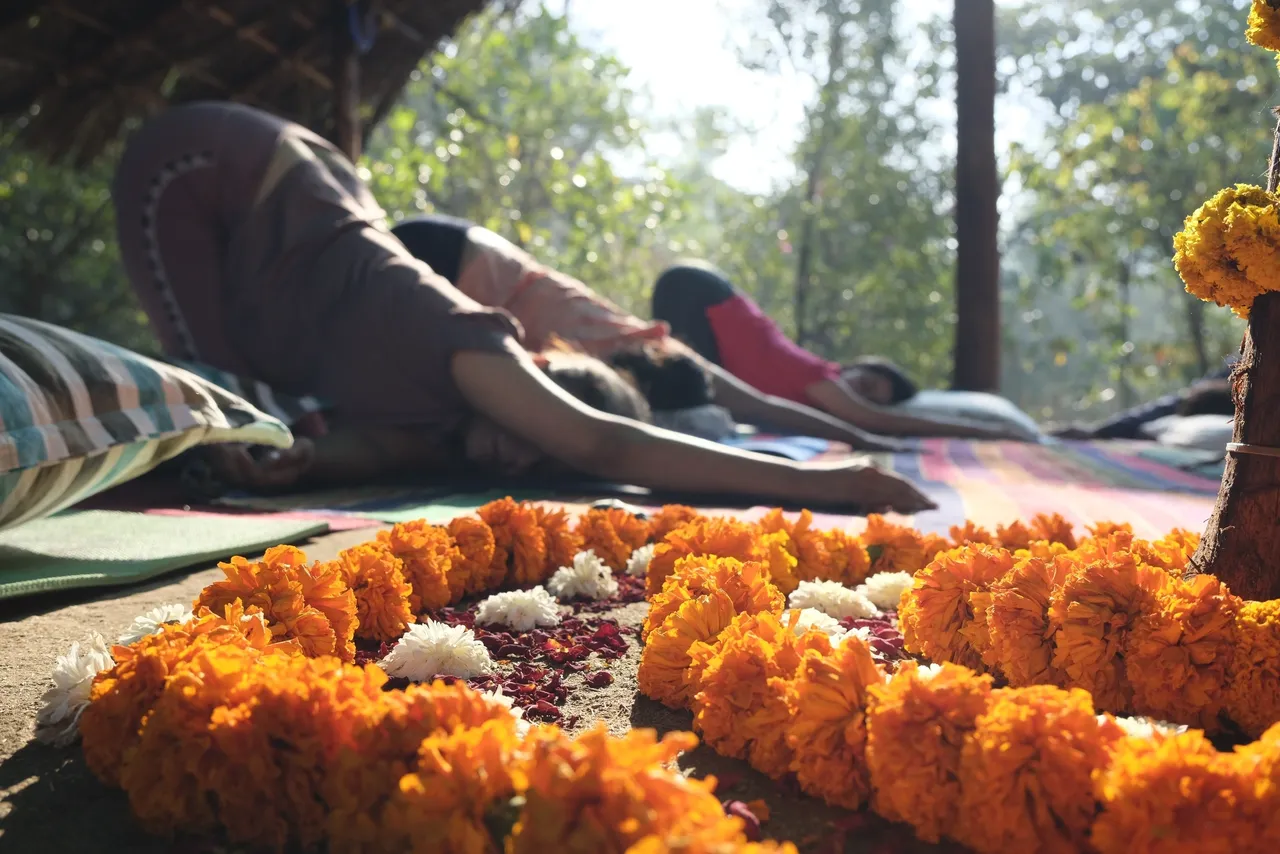
The garland and the mat belong to the same evening.
Around the circle of people sitting to practise, marigolds have been laid — orange and yellow, bright against the dark. Marigolds are for the Devi. The mat and the garland are not separate languages. Both say the same thing: this hour belongs to something other than the ordinary.
Nine Nights, Nine Doors
Navratri is nine nights of the Devi. It is said that a different form of her is honoured each night, and that she wears as many faces as she has: the fierce one, the tender one, the one still learning, the one who has already understood.
It is said. And still, when you sit with it, the number nine does something to the mind. Nine nights. Nine doorways. One room.
Because this is the only door that counts. The Devi who is worshipped in the corner of the house and the Devi who is worshipped in the silence between two thoughts are not two Devis. Her name means the shining one — and light does not stay in a corner.
The Fasting of the Mind
Most of us know the vrat, the fast of Navratri: the light meal, the day of fasting, the hunger that sharpens the mind more than any amount of sleep.
What is eaten is only half of it.
The mind, though, is rarely asked to fast. A fast of the mind is simply this: the deliberate not-taking. Not feeding the story. Not feeding the comparison. Not feeding the small irritation that has been asking for its breakfast every morning since you were a child.
The fast is not subtraction. The fast is a sharpening.
And she is not worshipped as someone who fights the darkness from far away. The Puranas tell of the Devi’s victory over Mahishasura, the buffalo demon. Many read the buffalo as our own animal nature — the part that wants to graze, to wander, to feed. The teaching of that story is not that she is stronger than you are. It is that she is what is left when you stop feeding the animal.
The Strength That Is Not a Muscle
We tend to imagine the Devi as fierce: weapons, a lion, a face that could frighten a thundercloud. And she is. But she is also the gentle one, the mother, the woman grinding the spices at dusk, the one who is tired and does not stop.
Inner strength is not hardness. It is the ability to stay soft and remain unshaken. A river can be soft and still cut through stone. That is not a metaphor. It is only physics.
Walking the Nine Nights
You do not need a pandit or a printed schedule to walk the nine nights. You need attention, and a little discipline — tapas, the steady heat of effort.
Take the nights in order, if you can. The first for the body: eat simply, sleep early, walk. The second for the breath: a little pranayama, a little longer stillness. The third for the senses: fewer inputs, softer light, less noise. The fourth and fifth for the mind: watch the story without answering it. The sixth for someone else, for no reason at all. The seventh and eighth for whatever is left when the list is finished. The ninth for the one who has been walking.
You will not get that far by effort. You will get as far as your attention takes you, and that is already the whole of it.
The Devi is not outside you. She is the shining one, and she has been waiting inside you the whole time, and she does not tire.
Nine nights. Nine doors. One room — and you were already in it.