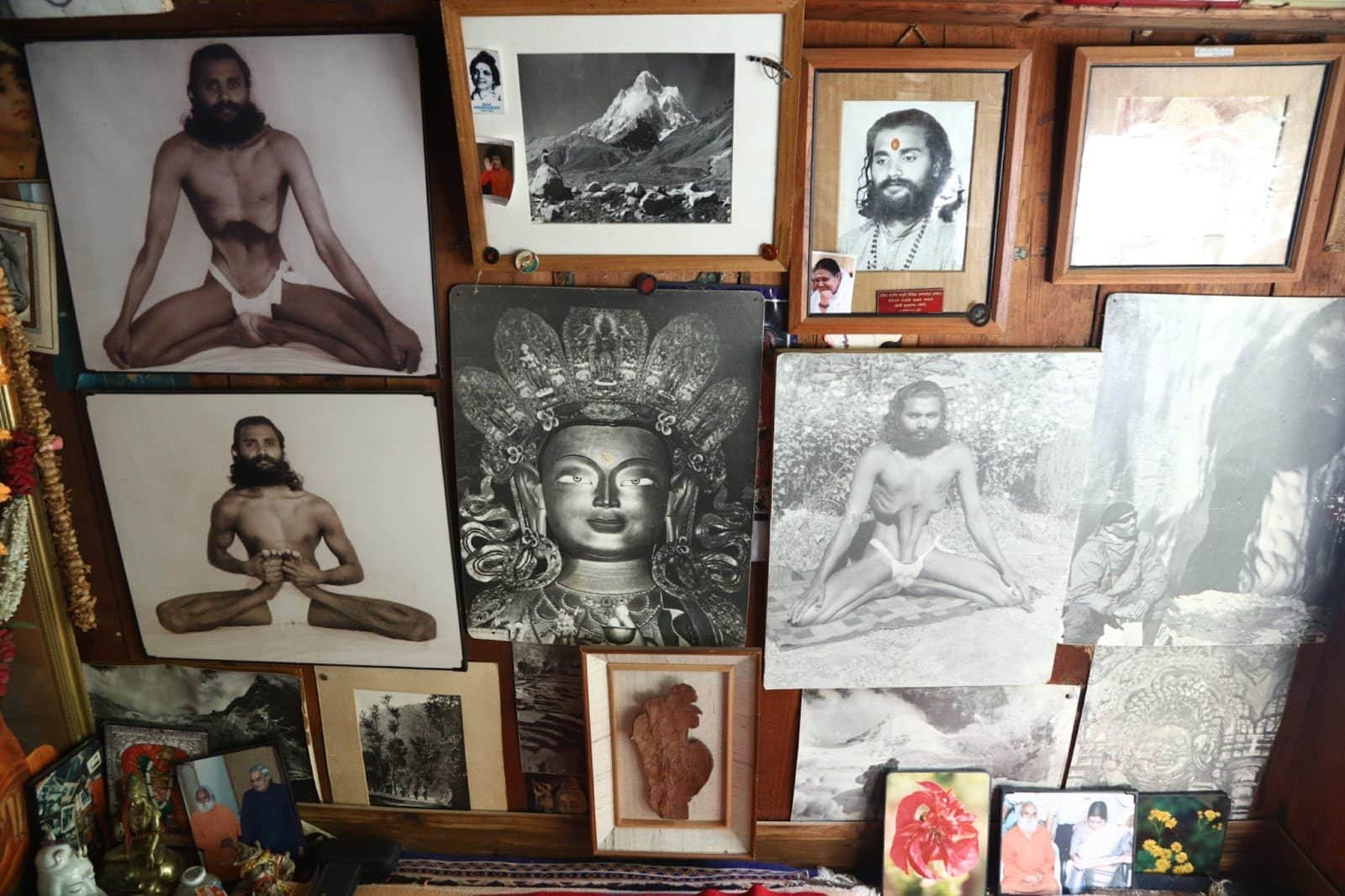
A wall of old photographs. Faces of teachers who never met you, who lived and taught and are gone. And a book that has been opened and closed a thousand times, in a hundred different hands.
None of it is decoration. It is a lineage. And it is an invitation.
The Practice Within the Practice
Svadhyaya — self-study — is one of the observances. It is often understood as the reading of scriptures, and that is true. But the word itself holds more: the study of what is written, and the study of who is reading.
Every text we open becomes a mirror. The Yoga Sutras of Patanjali, the Bhagavad Gita, the Upanishads, the Hatha Yoga Pradipika — they do not hand you new information. They give back your own, in a language older and cleaner than yours.
You read a line and something in you recognises it. Not “I have heard this before”. Something older. Something that was already there, waiting for better words.
A Teacher You Will Never Meet
Photographs of teachers are kept for a reason.
Every lineage is a chain of people who were told something and did not keep it for themselves. At Yoga Kiran, founded in Varanasi in 2016, we are part of such a chain, and we hold it lightly. We have our teachers. We have our students. We have the long line before and after.
Satsang — the companionship of those who are seeking, in the presence of those who have walked — used to mean sitting near a teacher. Now it can mean a room of strangers who put their phones away, or an online class where someone says, “I don’t understand this verse either,” and you are not alone in it.
You are not the first person to be confused by a sutra. You will not be the last.
The Book and the Mat
Let us be honest about a trap.
Reading can become a way of not practising. Words accumulate, the mind feels full, and nothing changes. The shelf grows. The mat stays folded.
And the other way round: practice without study is a traveller with no map, walking with great devotion in a circle.
The Bhagavad Gita holds a line that readers have carried for centuries:
The self lifts itself by itself. The self is its own friend, and the self is its own enemy.
Study is where the self lifts itself. It gives the mind something true to hold, and in holding it, the mind discovers what it is made of.
Studying the Self Through Study
Here is what we mean.
Reading for an hour is a form of meditation when the reading is honest — when you are not collecting lines to impress anyone, but turning a page and asking: who is the one reading this? The answer is usually not the one you expected.
Texts do not work on us from a distance. A sutra read and understood changes the way you breathe by the next morning.
So read slowly. Read the same passage again the next day, and the day after. Let a line sit in you until you can no longer tell whether you have understood it or merely recognised it. Mark nothing down. Do not hurry. The book is not going anywhere. It has been waiting longer than you have.
Then close it, and sit.
That is the whole method, and it has never needed more than this: study the text, then let the text study you.