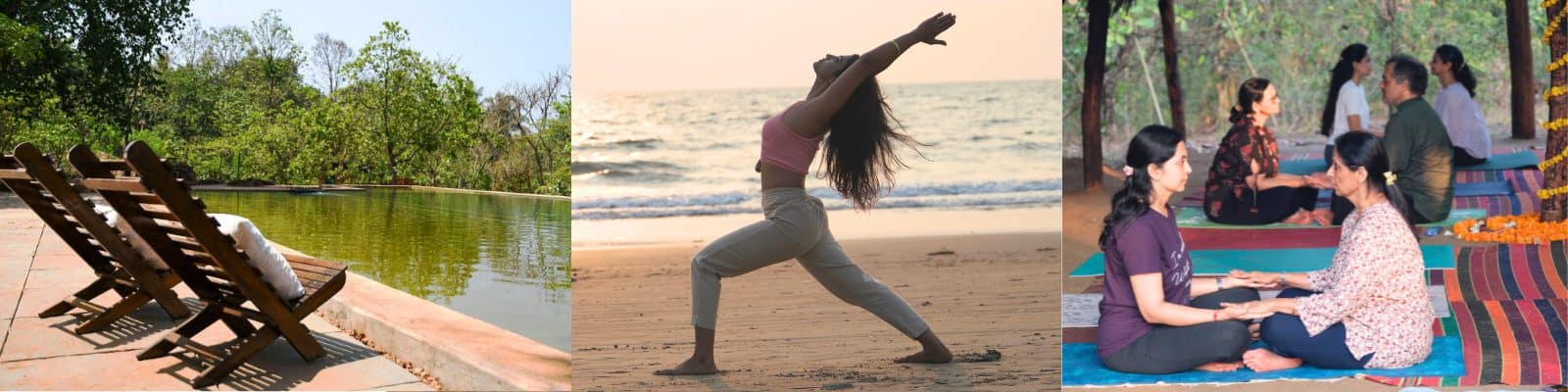
Before sunrise the beach in Goa is the colour of pewter. The tide has drawn back and left the sand written on — lines of foam, small shells, the long signature of the night.
This is the hour we come for. Not the pictures. The hour when the water is neither here nor there, and the body, if you let it, does the same.
We keep our winter retreats by the sea in Goa, in the months when the light is soft and the water is kind enough to walk into. But the truth is that the shore teaches you long before you arrive on it.
The sea breathes. It goes out. It comes back. Not fast. Not with instructions. On and on, without once being asked to.
The Tide Is a Pranayama
Pranayama, the practice of working consciously with the breath, is usually taught as refinement — longer retention, finer control, subtler sensations. The sea offers a simpler version. Stand at the edge and match your breath to the water. For a few breaths it is a trick you are playing on yourself.
Then it becomes true.
The chest fills on the sea’s time. The shoulders drop as it draws back. Something along the spine stops working so hard. This is not a metaphor. The body has been keeping tides for far longer than it has had a word for breath.
Some teachers count the waves and let the count become the count of the breath — four waves in, four waves out — until the difference between the two becomes impossible to hold. It is old, practical, and entirely uninterested in poetry.
The word yoga comes from the root yuj, to yoke or to join. The sea does the yoking for you, without any of the vocabulary and without asking for anything in return.
What the Sand Remembers
By six the beach belongs to a few of us and the birds. The sand still holds the night in its footprints, softening a little with every breath of wind.
Watch what a body does near moving water. The practice changes without anyone deciding it. Poses lengthen. The transitions slow. Someone who has been holding a shape for a minute and calling it discipline finds themselves standing in the sun, doing nothing, simply listening.
This is not rest. It is attention without an object — pratyahara, the withdrawal of the senses — arriving unbidden, the way sleep arrives when you finally stop trying.
Walk out far enough and the water comes after you. That is another lesson, and a less poetic one. The shore is not permanent either. Everything you are standing on is already on its way back to the sea.
And here is the strange mercy of it. The sea has no memory of yesterday’s practice. Every wave arrives as if for the first time. Sitting by it long enough, you stop measuring yourself against what you managed last week.
Returning Is the Practice
Here is the part we did not expect.
We came for a week. We went home. We came back — not for the shape of the practice, but for the water. The same walk. The same hour. The same salt. We have watched it happen more times than we can count, and it is the reason we set the mats facing the water before the sun comes up.
We have watched people arrive at the shore tired in a way that sleep had not touched. Twenty minutes on the sand, facing the water, with nothing to be done — the shoulders come down. The jaw comes down. The breath, knotted high in the chest, finds its way down.
Not a cure. A reprieve. A remembering of the order of things — that the body comes first, and that very little else can be carried in it for long.
The tide keeps no record of who watched it. It does not need to. It only keeps coming back.
And when you are ready to practise with us — online, or by the sea — the water will still be doing what it does. Bring only your breath.