The road to Gaumukh ends where the Bhagirathi begins.
There is a glacier up there, a mouth of ice said to be shaped like a cow’s, and the river coming out of the mountain with the force of something that has been held a very long time. People have walked here for centuries. The walk is part of the tradition, not a detour around it.
The Walk Is the Practice
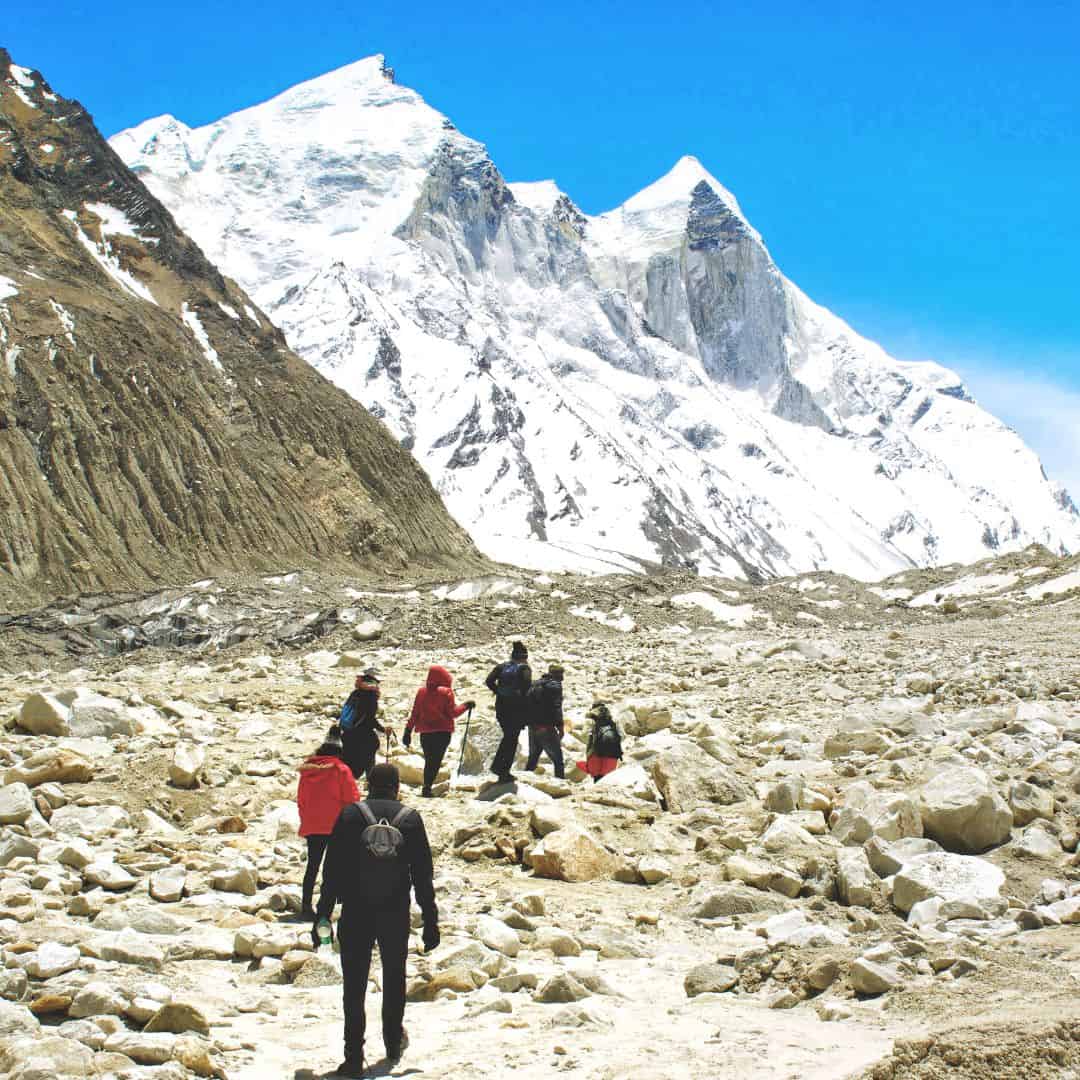
The road runs as far as Gangotri. Beyond it, the way is on foot — past Chirbasa and Bhojbasa, up through rock and the thin cold air, beside a river that runs loud in a wide bed of stones.
The view is enormous, and after the first hour you stop looking at it. There is nothing to do but put one foot in front of the other for hours.
This is the part people remember years later. Not the source. The walking.
Carry less. That is the first rule of the path, and it is not only about weight on your back. A lighter step is a quieter step, and a quieter step leaves room for the sound of the river, which is closer than you think.
Because a mantra, a phrase or sound repeated to steady the mind, is something the body can make for you. The count of the feet. The sound of the breath. The chip of the boot on stone. The way the mountain teaches you a rhythm and then, without saying so, teaches you to stop arguing with it.
Bhagiratha’s Long Wait
The story of the river’s descent is told in the Bala Kanda of the Valmiki Ramayana. Bhagiratha prays for years — tapas, the discipline of heat and patience — until the Ganga is released to the earth. Shiva holds her in his locks. She passes through the sage Jahnu and comes out by his ear, and she is called Jahnavi for it.
Years. That is the detail worth keeping. The river did not come because he was powerful. It came because he stayed.
The River That Carries Everything
Ganga is not a clean river. She carries silt, and the ashes that are given to her at Varanasi, and the prayers of people who never saw her. She is the river that does not refuse.
The old telling says her force would have shattered the earth, so Shiva caught her in his hair and let her down gently, a little at a time. That is the whole of what the walk asks of you. Not a dramatic arrival. A slow descent into the world, with enough strength to carry what you find.
And the carrying is not a burden. It is the shape of the river.
The Source Is Not a Place
At the top the river is small and cold and ordinary. It does not look like the Ganga at Assi Ghat or at Dashashwamedh, thick with lamps and voices. It is a thread of water over stones. It is the same water.
People stand in it. And what happens is not that the mountain gives something up. It is that you recognise something already moving in you.
You do not come to the source to become someone new. You come to see that you have been walking toward something that was already here — and that the walking was never wasted.
The river does not remember Gaumukh. It only keeps going.
So, in the end, do you.