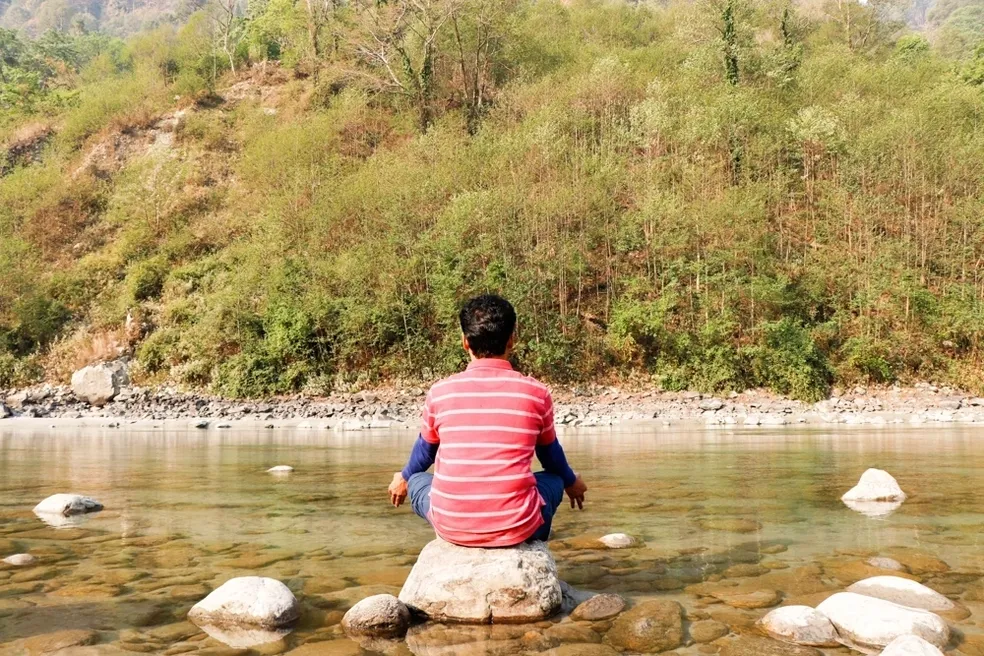
Stand beside a stream in Uttarkashi for ten minutes without reaching for your pocket, and something unusual happens. The world does not go empty. It goes specific.
A bird. Water over stone. Wind in a birch. The sound of your own breath, which was there all along, drowned out by everything you were listening to.
The word for this is pratyahara — the withdrawal of the senses.
The Senses Are Not the Enemy
There is a way of thinking about the senses as a problem to be cured. The eye that will not stop looking. The mind that will not stop wanting the next thing. The feed, the news cycle, the small red number on the screen that has learned to speak in a voice like a friend.
But the senses are not the mistake. They are instruments, and they work beautifully — outward, always outward, in every direction at once. The eye toward the world. The ear toward the next sound. The tongue toward whatever comes next.
Pratyahara does not break the instruments. It turns them. Gently, the way a river can be persuaded into a new channel without any violence at all.
The Bhagavad Gita compares the steady one to a tortoise drawing its limbs back into its shell. The Gheranda Samhita gives pratyahara a whole chapter of its own, which tells you how seriously it was taken.
The Age of Constant Input
We have built a world that asks the senses to report constantly and asks nothing in return. Nothing in it is asking to be your whole life, and yet it takes so much of your life.
So the withdrawal is not a retreat into a cave. It is a small refusal. To leave the phone face down for the length of one breath. To walk a familiar street and let it be unfamiliar again. To hear the temple bell without also hearing everything the bell reminds you of.
Not silence. Presence.
There is another way to think about all of this, and it is not withdrawal so much as return. The senses have been sent out into the world for so long that most of us have forgotten they are ours to call back in.
Turning the Senses Home
Here is the part that surprises people. The senses are not the destination. They are the doorway.
Patanjali speaks of the seer, the one who stands behind the senses, unchanged by them. That is where they are going. Home is not the quiet room; home is the one who was quiet all along.
How does one travel there? Slowly, and in this order. With the body first — asana, the shapes that make a seat possible for long enough. With the breath — pranayama, the deliberate slowing of what is always speeding up. With attention itself, which is the only luggage worth carrying.
Mostly with repetition. Pratyahara is not an experience you have once. It is a direction you turn towards, gently, again and again, until turning is easier than not turning.
One warning, from experience. Withdrawal that becomes numbness is not pratyahara. It is only another noise. The senses should come home quieter, not smaller. If you have gone blank rather than clear, you have gone too far, and the way back is the senses again — slowly, one at a time.
The world has not left. It has come closer, and it has stopped shouting.